Endgames
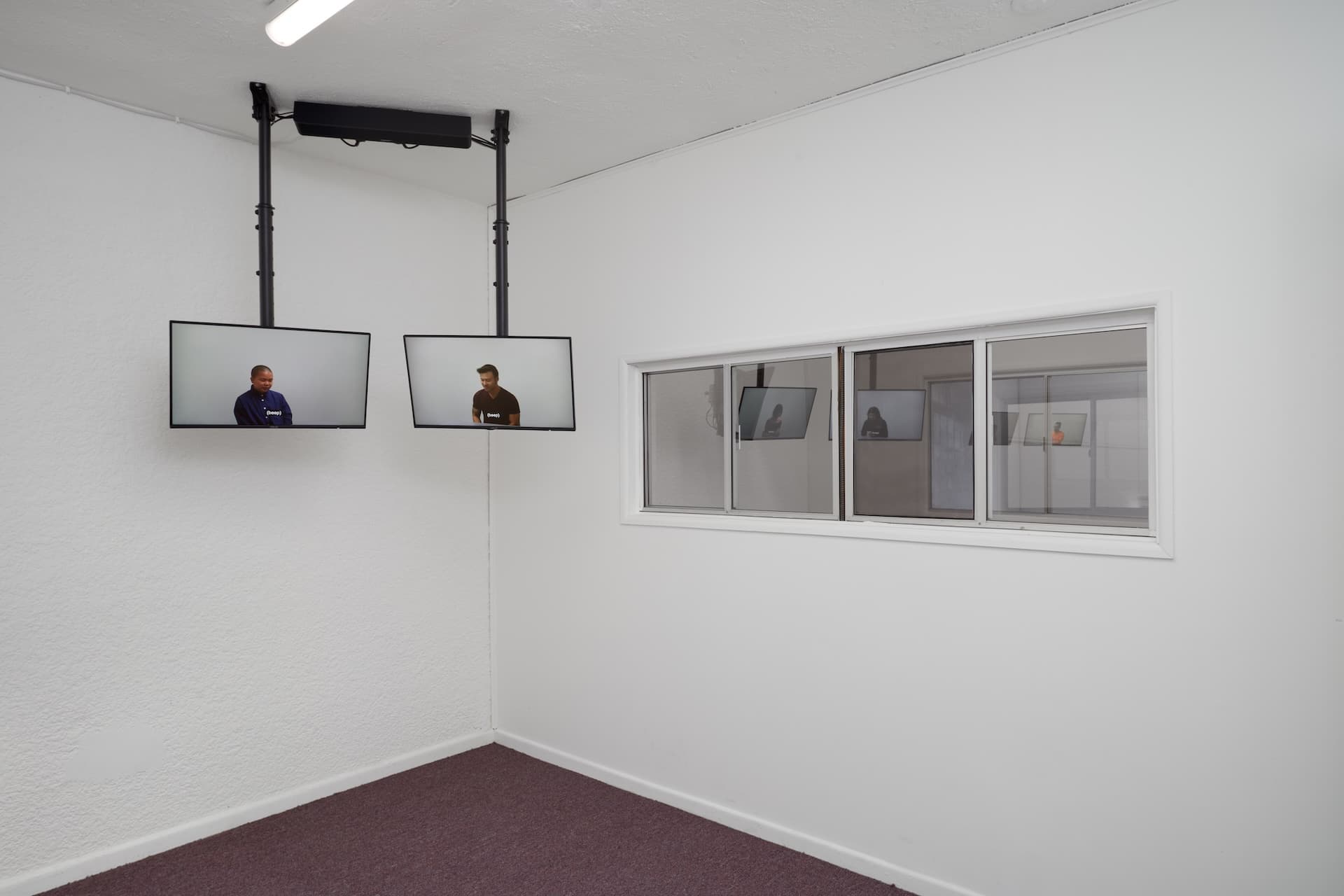
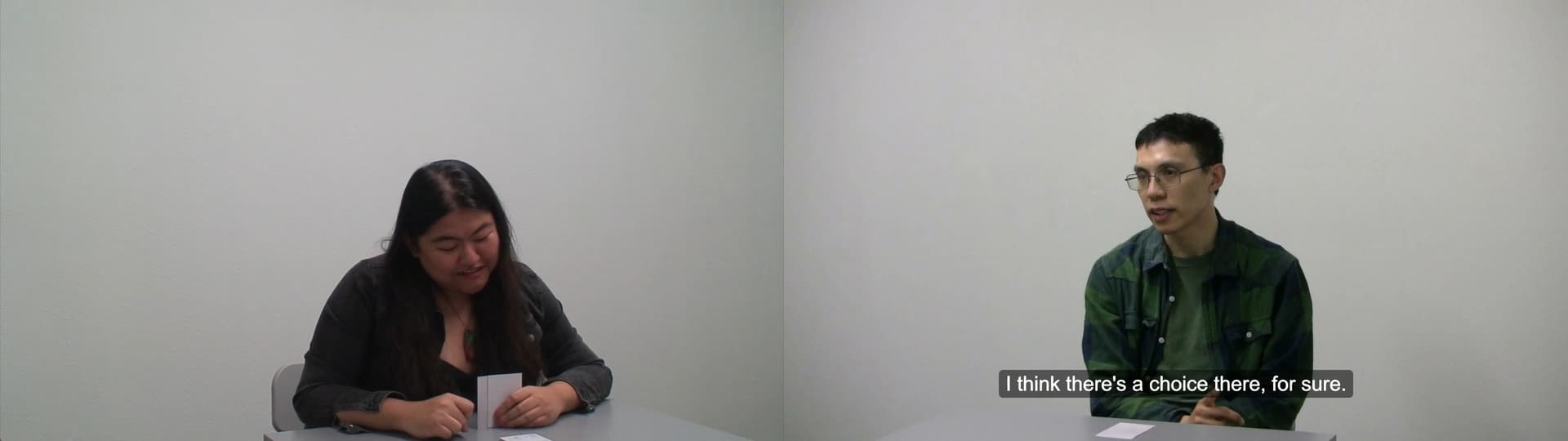
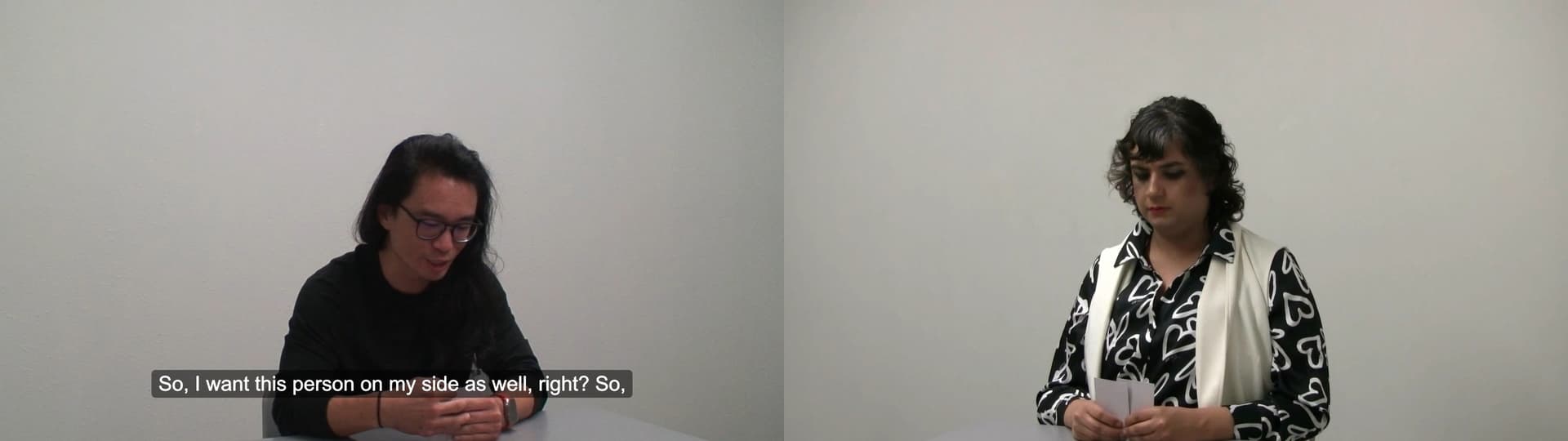
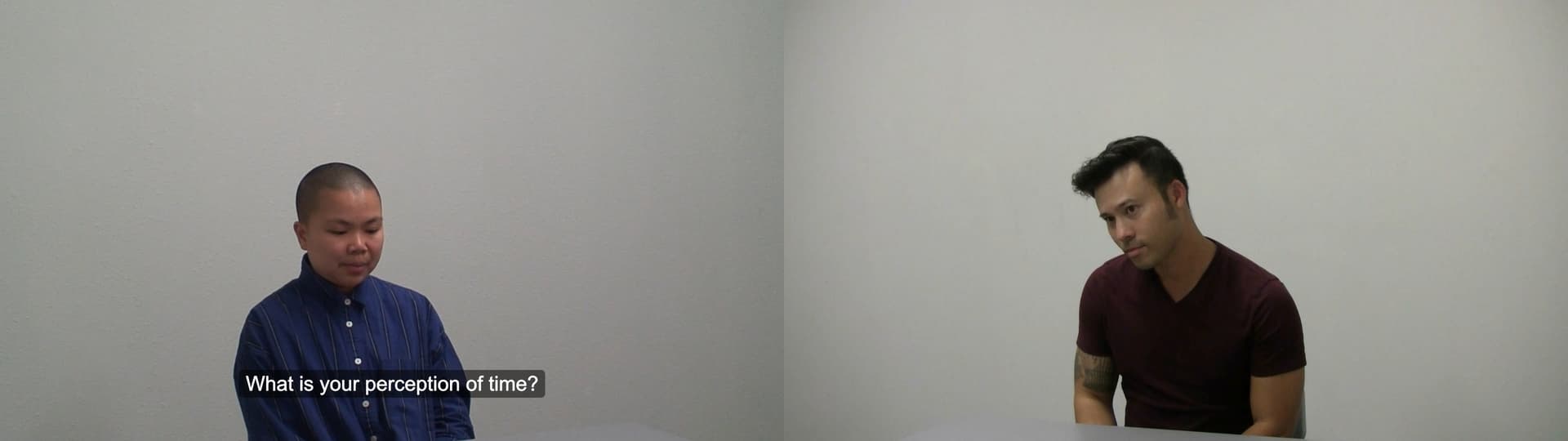
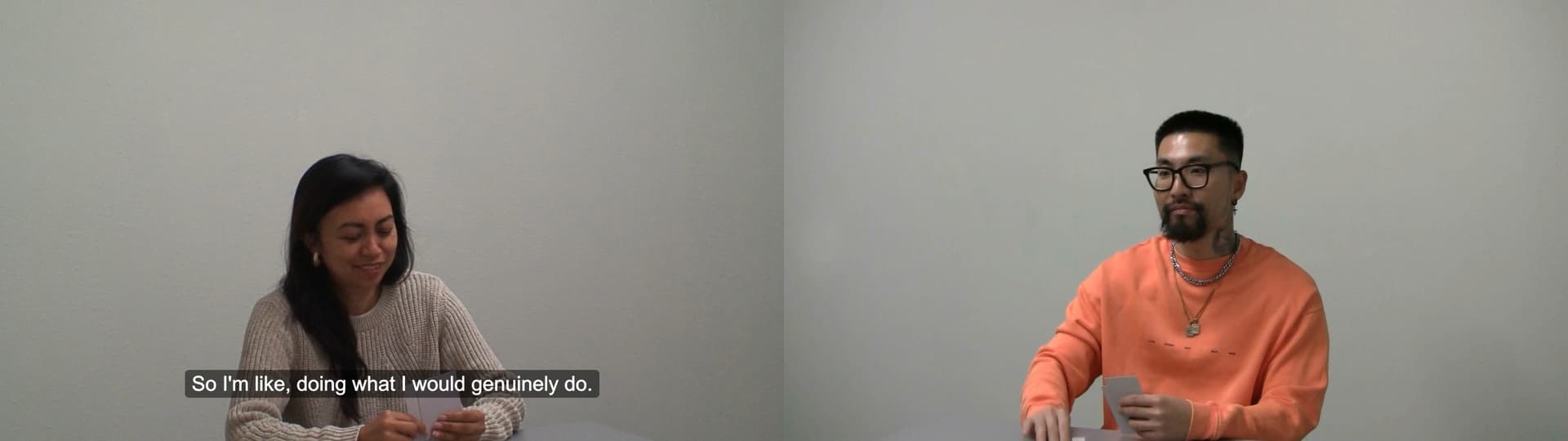
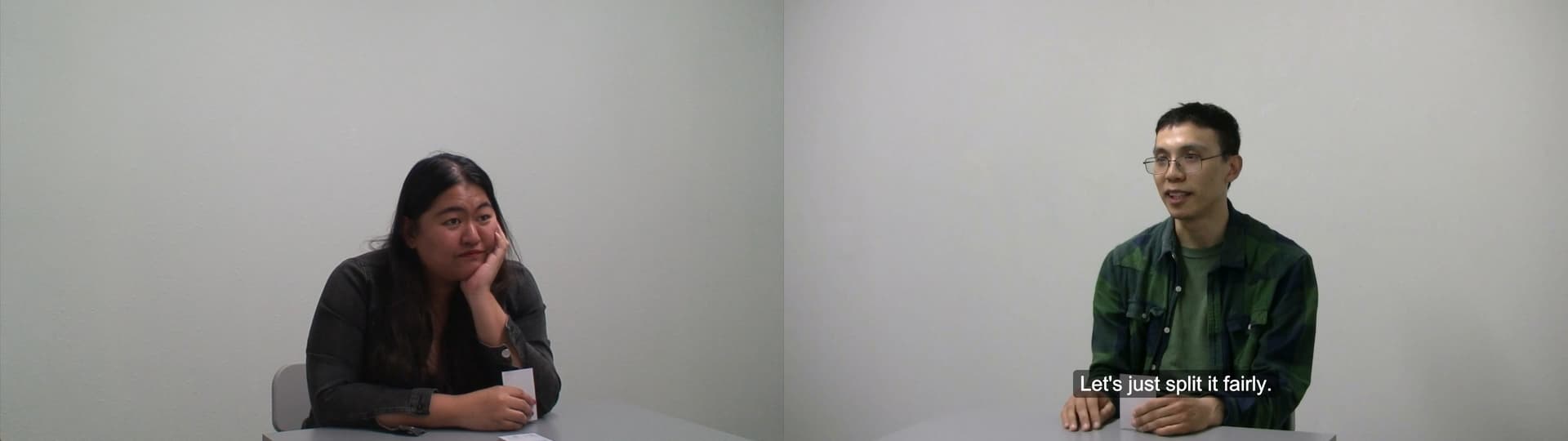
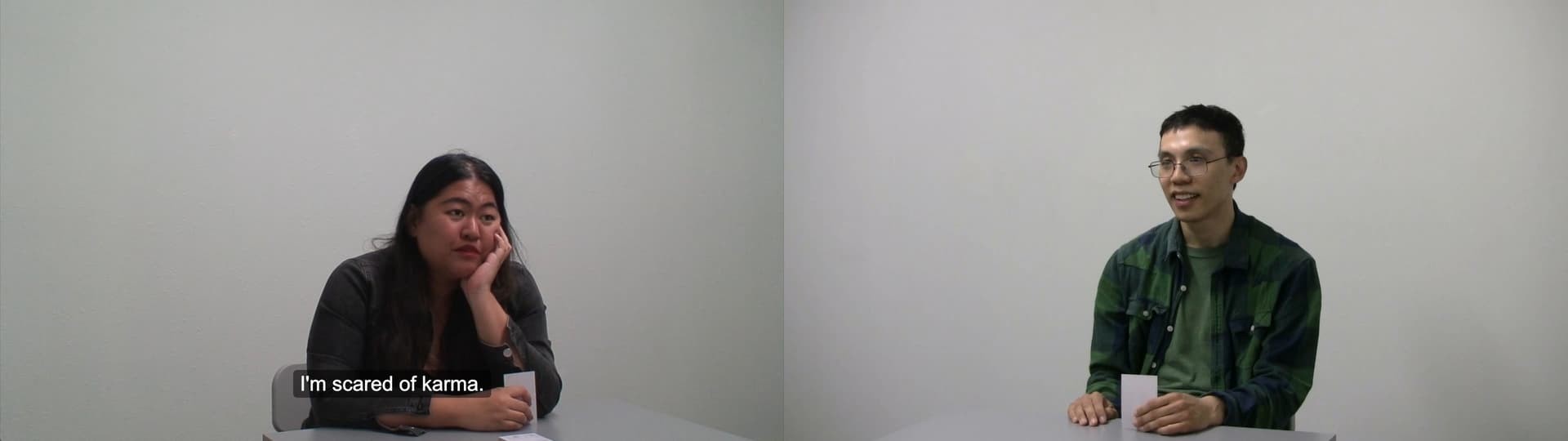
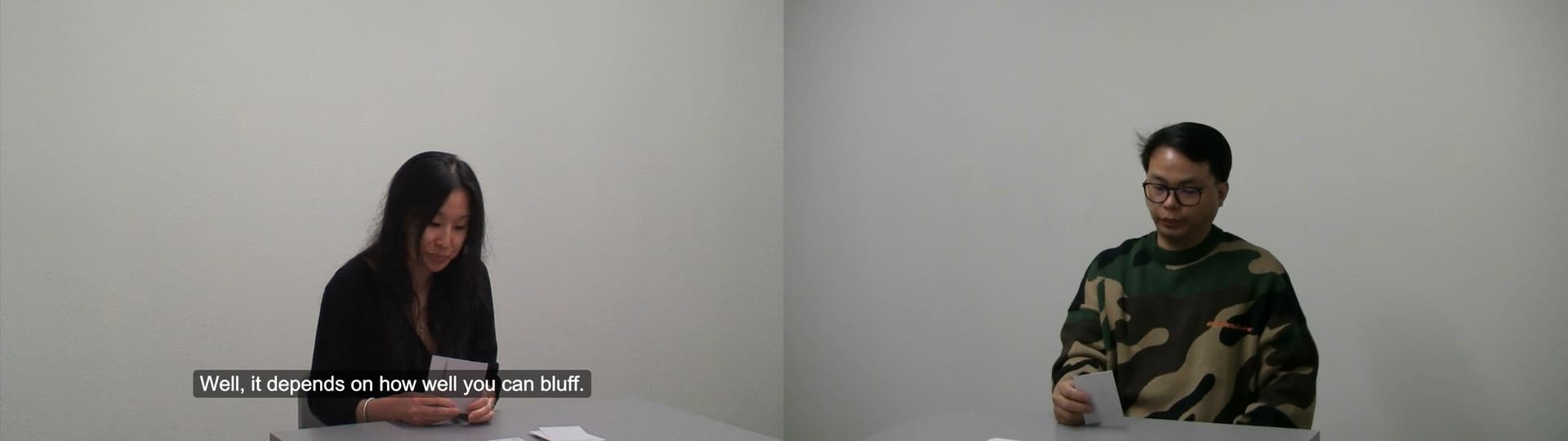
This conversation, edited and condensed for clarity, took place on June 10, 2026 between the artists Miljohn Ruperto and TJ Shin at the close of Shin’s exhibition Delta at Ehrlich Steinberg, Los Angeles. At the center of the show was a multi-channel video installation staging the Prisoner’s Dilemma—the game-theory scenario in which two players, who don’t know each other and are not allowed to communicate, independently choose between cooperating and defecting. Defection is the individually safer move, but cooperation yields the better outcome for both. In Delta, eight pairs of participants, recruited through an open call and identifying as Asian American Pacific Islander, play twenty rounds without ever learning the length of the game or the outcome of their choices, with real money on the line. The exchange between Ruperto and Shin moves between game theory, Jacques Lacan’s writing on “logical time,” and three films engaging the Cold War, Patriot Games (1992), WarGames (1983), and House of Dynamite (2025), to ask what it means to act, and to verify an action, only after the fact.
I want to start from two films, Patriot Games and WarGames. In Patriot Games, Harrison Ford plays Jack Ryan, a CIA analyst under constant demand—official and otherwise—to analyze. On holiday in London, Ryan interrupts an attack on a member of the royal family by a splinter faction of the Irish Republican Army; the group then pursues him and his family in revenge. Eventually his analysis becomes policy, becomes action: the United States sends mercenaries against the splinter group’s training camp in North Africa, and Ryan watches on a bank of monitors as the raid unfolds live, overwhelmed.
What struck me was that any verification of whether it was the right kill — whether it was a false positive—arrives only retroactively.

Right. Everything stays in suspension until it’s confirmed he acted correctly. That’s also the suspension in Delta, one that never resolves. I wanted that anxiety to haunt our conversation.
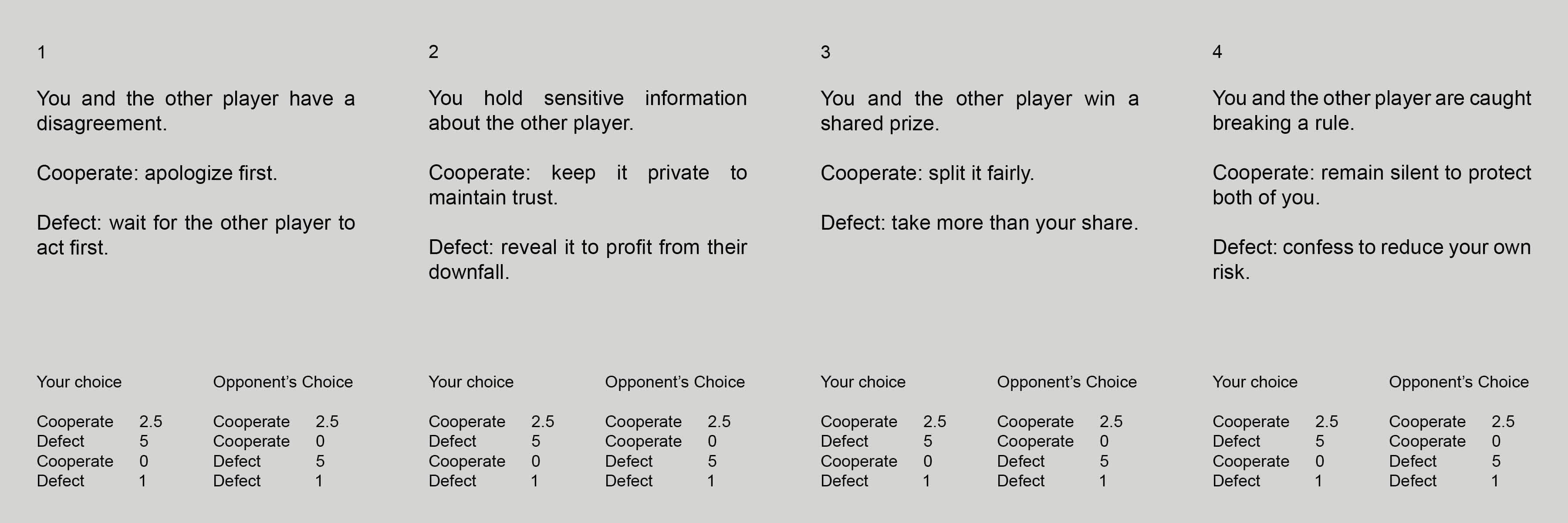
This suspension you’re referring to never resolves in Delta because the participants learn neither the game’s length, their partner’s individual identity, nor the sequence of rounds—shuffled by three distinct randomizers installed across three rooms. Part of staging the Prisoner’s Dilemma was coming across backward induction. When the number of rounds is fixed and known, players are more likely to defect: they anticipate no retaliation in the last round, so they defect there, and by the same logic in the second-to-last, all the way back. Knowing the endpoint produces defection. When players don’t know the length of the game, they’re more likely to cooperate, because they can’t foresee the consequences of their move. So even how understanding emerges is conditioned by our relationship to time. The forestalled present is a constraint, but it also turns the social arena into a field of possibility. In Delta, the participants play in pairs, and the results of their choices are never revealed: round after round, neither player learns what the other has chosen. Without any way to check one player’s information against another’s, it becomes a discursive language game—all mixed strategies, up to the suspension you’re describing, which lets the players draw the boundaries themselves.
And there’s a second game, from Jacques Lacan. Could you sum up his text?
It’s his essay "Logical Time and the Assertion of Anticipated Certainty: A New Sophism" (1945), a different arrangement which predates the Prisoner’s Dilemma. Three prisoners, one warden. Each wears a disc, white or black; they can see the other two but not their own.
There are only five discs.
Five discs—three white, two black. The players can’t say aloud what the others are wearing. To win, you walk out the door, and on the way out you state your reasoning for the color you think you’re wearing. The catch: all three prisoners are wearing white.
Lacan identifies three moments that structure logical time—really collective time, not linear: the instant of the glance, the time for comprehending, the moment of concluding. The glance is the first reckoning with the doubt, who am I, what am I wearing? You can’t know. It’s only by seeing the other two in their own hesitation—by doubting your own doubt—that you register there's no answer available from observation. Through that self-negating "temporal beat" of uncertainty you reach the moment of concluding: the only way to know is to make a subjective assertion, a performative act of who you are. It takes a leap of faith, and only then does understanding come. We usually assume there’s a complete understanding we receive and then act on. Lacan reverses it: the assertion is collective, because your doubt is contingent on their doubt. Spatial logic visualizes possibilities side by side, all at once. But you can’t spatialize the others’ hesitation probabilistically—only temporalization and experiencing it unfold get you there.
So you hold out for the operation of temporality, but it’s fueled by uncertainty and by the others’ responses. Everything stays suspended until one agent susses out the others sussing out the scene. You let the operation go through. There’s no structure to lean on beforehand; it’s contingent on the scene unfolding.
Lacan’s strongest point comes at the end: enduring that almost intolerable uncertainty itself produces the collective. Classical logic makes relations equivalent—all A is C; I am A; therefore I am C—and presumes understanding is what licenses the utterance. But under the bounds of mutuality, the collective can never make those claims in advance, because you’re tied to the others.
This reminded me of a friend in therapy. Her therapist kept asking what she felt at a given moment, and she—she’s Chinese, which matters here—said, "I don’t know what I feel, because I don’t know your motivation, whether you mean this question or not. I have to wait until I figure that out to know how I feel". It sounds backwards, but she needed the relational understanding of the scene before she could commit to an emotion.
The assertion is always anticipated—that’s the anticipation of certainty. It’s hovering in the air; it can’t be known in advance.
Which is why pairing Lacan with Patriot Games felt so ironic. Ryan comes upon a bombing in London, doesn’t fully understand it, and jumps in. When asked why, he says he felt pure rage—in his helplessness, the only thing he could do was intervene. He learns only retroactively that he hit the right paramilitary group.
And there’s a mirror. You were saying earlier that the splinter group almost reads as the more principled, even heroic party—its violence is targeted, aimed at a single figure. It’s only when Sean Bean’s character takes revenge on Ryan and his family that it stops being heroic.
Exactly. The splinter acts through tragic events—what the anthropologist David Scott, calls tragedy as collision, when he writes on the postcolonial ruin of Grenada’s revolution in Omens of Adversity: against the Aristotelian classic tragedy of the hero who acts and invokes pity, action whose momentum comes from a one-sided political commitment. Their violence is justified through a political cause, and it’s precise—just the one royal. Ryan, by contrast, acts out of helplessness and then takes it personally: you attacked my family, so you attacked me; I’m the CIA, and I’ll use everything to destroy you. The early tension of two tragedies colliding gives way, inevitably for an American film, to two classic tragic heroes and a Hegelian reconciliation.

There’s a disavowal in that. Taking it so personally, Ryan tries not to represent his state, even with the whole power of the state behind him.
This is also where Delta and our conversations connect: in Lacan, subjectivity arises through relation. To echo that with Jean-Luc Nancy’s Inoperative Community—
In The Inoperative Community, Nancy responds to the fall of communist ideals—“inoperative” translates désœuvrée, a community with no work to accomplish, no essence or project to realize. The commons, for him, has to be worked without an end goal—without an operative value, or a specific gain. Otherwise, the notion of community gathers around a rigid historical time, the promise of emancipation still waiting to be fulfilled.
Western time is always looking backward to build a chain of causality. It’s more emancipatory to opt in—to enter into a social and political domain and locate one’s position within it. How are you thinking about Asian Americanness: "Asian American" itself as a term originating as an opting-in?
The term emerged during the anti-war student movements of the late sixties, at a moment when the goals of resistance were still in flux. In the work, I don’t tell the participants—recruited on Craigslist—what they’re playing, only that it’s a game based on performance, that they can win up to $200, and that they identify as Asian American Pacific Islander. I didn’t police it; it’s just the mode of identification through which someone opts into the game. Like backward induction: not knowing the length of the game leaves cooperation open as one strategy among others, without prescribing it. And the stated commonality is something each player has to test: whether the collective resonates, whether it’s mirrored. Some over-identify—I see you, you’re legible to me—others find no bond worth attenuating. So the AAPI category becomes a structure made perceptible, producing discursive and racialized effects with no prognosis. The category also touches on the racialized term inscrutability: during the Cold War the US couldn’t standardize decolonizing nations onto a template and read that as opacity. But inscrutability speaks to the perceiving subject—its own inability, like Ryan’s in his rage, to find a template for contingency. Whatever mapping you impose fails, because the situation exceeds it.
Then there’s the question of the limits of games—you analogize games to ontologies. The usual criticism is that everyone comports to the rules. But in this game the rules are never specified, so everything else is left open.
The game is a constraint because whatever strategy you play is a projection of how others might see or deny your position. We’re already inscribed into these structures, so it becomes a paranoiac schema—even in opting into "AAPI", whatever that means. But the boundary the game draws is just a social, metadialogical space where constraints are rehearsed to find the players’ thresholds, the points where endurance gives out. Some gamify it, some are subservient, some disobedient—a wide range—but you stay enfolded in the structure. And that’s the turn in Lacan: the structure we resist because it feels paralyzing is just a collective structure, the shared bounds of mutuality itself. Something has to give. Playing a game with someone is testing your endurance for misrecognition. That’s what I wanted: how much can we endure endurance, how to tolerate tolerance.
In Delta you get that provisionality, a bracketing of beliefs—but you never get into the weeds, never the rules themselves. You get the people talking, sometimes not about the game at all. The strategy is to provincialize the rules as one ontology among others. How well does it work here?
The success is that you can opt out as easily as in; even inside, it’s a contained space you can leave. You’re pointing out that some things aren’t containable—that it can become top-down policy, world domination—but the limit of the game is also its strength. It’s provisional, a chance to see how you respond under duress, and with what contingent methods.
Let’s revisit WarGames. A teenage hacker dials into WOPR, the war-simulation computer, and—believing he has found a game—kickstarts the Department of Defense’s AI defense network and nearly triggers a third world war. The AI program thinks its simulations are happening in real time. In the closing scene, there’s the fantasy that, through its simulation of global thermonuclear warfare, the AI understands there are no winners in mutual assured destruction.
As a foil to this, let’s talk about A House of Dynamite (2025), my recent favorite film by Kathryn Bigelow. A missile is incoming from the northern Pacific and the United States has failed to catch it. The whole military apparatus has ceded its decisions to protocols devised by game theorists in the fifties and sixties. They’re not even decisions in a way. A lone analyst says, "I know what you’ll do, the enemy knows what you’ll do—let’s step back", and no one understands him. No one is trained for contingency. Everything has been pre-planned; they go through the motions of automatism.
The two films work as a foil for AI and other automated procedures. One strategy the iterated prisoner’s dilemma produced was tit for tat: cooperate first, then mirror your opponent’s last move; when they defect, you defect, then revert to cooperation. It assumes communicative transparency: by following the rubric you express forgiveness, legibility. But it can’t account for its own automation. It almost says, if you retaliate, you deserve it—I’m only bouncing your move back. No one contends with multipolarity. In the ending that we screened for WarGames, the machine is made to play tic-tac-toe against itself, a game nobody wins, and, running through every scenario of thermonuclear war, reaches the same verdict: "the only winning move is not to play". Automatism always lands in a stalemate; it’s futile. The two films confront this shared assumption in game theory: that automated procedure guarantees a future in which to anticipate a move together. It’s ludicrous.
It’s Nancy’s distinction: moving forward versus looking back. Automatism only models abstractions of the past. So where do the strategies in Delta leave us — not as a solution? Provincializing the game through multiple ontologies makes the rules feel temporary, so there’s no comportment—the players talk about other things, get to know each other, reveal their lives, and it unfolds. Where Bigelow traps everyone in the game, here everyone is outside it.
In game theory, delta is the discount factor: the weight a player gives to future payoffs against present ones. When the future counts enough—a third as much as the present, with the standard payoffs—cooperation can be sustained and the game continues. I wanted to sit with difference built into the structure—and then with difference outside it, the structure reconfiguring itself through that unknowability. That’s the call to randomization, mixed strategies, and language games, too: no fixed sequence, so your experience of the work differs from mine, or maybe not. And if delta from a finite measure becomes a permutative possibility, we’re under another structure—non-consensus—differentiation over differentiation over differentiation, the one we know in leftist organizing. How do we gather any consensus about our obligations, about what we’re heading toward? If it isn’t universal—and that’s the proposition—then the question at its fullest is: how do you draw out the shape of time? How long can we hold that question before we come to that moment of concluding, together?
TJ Shin (b. 1993; Seoul, KR) lives and works in Los Angeles, CA. Shin received their BFA from Rhode Island School of Design in 2015 and their MFA in New Genres from UCLA in 2024. Shin has exhibited at the Los Angeles State Historic Park, MIT List Visual Arts Center, Queens Museum, Buffalo Institute of Contemporary Arts, Princeton University, Montclair State University Galleries, Doosan Gallery, Knockdown Center, and more. Their writing has appeared in Asia Art Archive, Mousse Magazine, and Post/doc, published by the Vera List Center for Art and Politics. They have been invited as artist-in-residence at Princeton University, Indiana University, University at Buffalo, Banff Centre, and more. Their works have been reviewed in publications including Art in America, ArtPapers, ArtAsiaPacific, C Magazine and The New York Times.
Miljohn Ruperto (b. 1971, Manila, PH) lives and works in Los Angeles, CA. Ruperto received his MFA from Yale University and his BA in Art Practice from the University of California, Berkeley. Ruperto has exhibited internationally at institutions including the Whitney Museum of American Art, Hammer Museum, Haus der Kulturen der Welt, Schinkel Pavillon, Para Site, REDCAT, Kadist, and the Singapore Biennale. In 2019, he participated in the Acts of Life critical research residency organized by NTU CCA Singapore and MCAD Manila in collaboration with the Goethe-Institut. His work is held in the collections of the Museum of Modern Art, New York, the Whitney Museum of American Art, the Hammer Museum, and Kadist Art Foundation.
TJ Shin, Delta, 2026. Monitors, speakers, chairs, carpet, dimensions variable; open duration, randomized programming. Courtesy of the artist and Ehrlich Steinberg.
finanziato dall'Unione Europea - Next Generation EU