The Given
The course took place in the basement of an East Village theater. To come and go from the instructional space required curling one’s body in adjustment to the zero-gravity corridor formed by a narrow, matted grey staircase suspended between floors. On the lower end of that passage, the rules were different; beyond explanation, and not of our reality. Experience split: one end determined by the empirical, the other by fiction. The interval between the two realms was necessary: one couldn't exist without the other, but they couldn't exist simultaneously.
Through an August spent in this basement, I came to understand that one’s physicality, and, by extension, perceptual identity, is constituted by a confluence of patterns. “We are perfectly adapted to live lives as ourselves,” the instructor said, “the real work begins only once we learn to interrupt habit.” This was the primary goal of our training: to override our automatic responses in order to open up alternative bodily realities. We turned our attention inward, attending to the minutiae of our physical experience—systematically resetting the spine, limbs, and jaw to release accumulated tension. The process was bewildering; participants experienced irritability, shortness of breath. Still, without fail, we gathered each day in the dim basement and sought to deconstruct the deeply ingrained patterns that shape our personhood. We were encouraged to inhabit the symptomatic discomfort, to refine it. To default into one’s habitual emotional or physical response is, in essence, to practice being oneself—a role already mastered.
Several months later, amidst a prolonged period of readjustment to self, I board a Blablabus from Paris to Brussels. The budget-brand bus is grey and matted, more contemporary than a school bus. Still, I have the feeling I'm on a field trip. Outside the window, I see swirls of bundled hay. I'm in Antelope Valley. I’m going to California Adventure, to Magic Mountain, a desert oasis. Adrenaline-tinged, every encounter with Lutz Bacher harkens back to this initial experience of Magic Mountain, her 2016 exhibition at 356 Mission in Los Angeles. I was in my first year of art school then; my prefrontal cortex, the brain's largest region of grey matter, was not yet fully developed. Lutz’s exhibition came over me as a phenomenon, received without defense; it recast the structure of viewing, leaving it permanently askew.
Some years later, I encountered Lutz's loop of Elvis's falsetto from Blue Moon in the basement of the Fridericianum. As I washed my hands in the bathroom, I caught the reflection of a woman in black sunglasses and grey-blonde hair slink out of the stall behind me, and up the stairs. At the onset of the exhibition at WIELS, Smoke (1976) features a filmstrip-style portrait of a woman posing in a folding chair—matte and nondescript like those you might assemble for an AA meeting, the kind we sat on in the theatre’s basement. Is the woman pictured the same one whose reflection I caught in the Fridericianum's bathroom mirror?
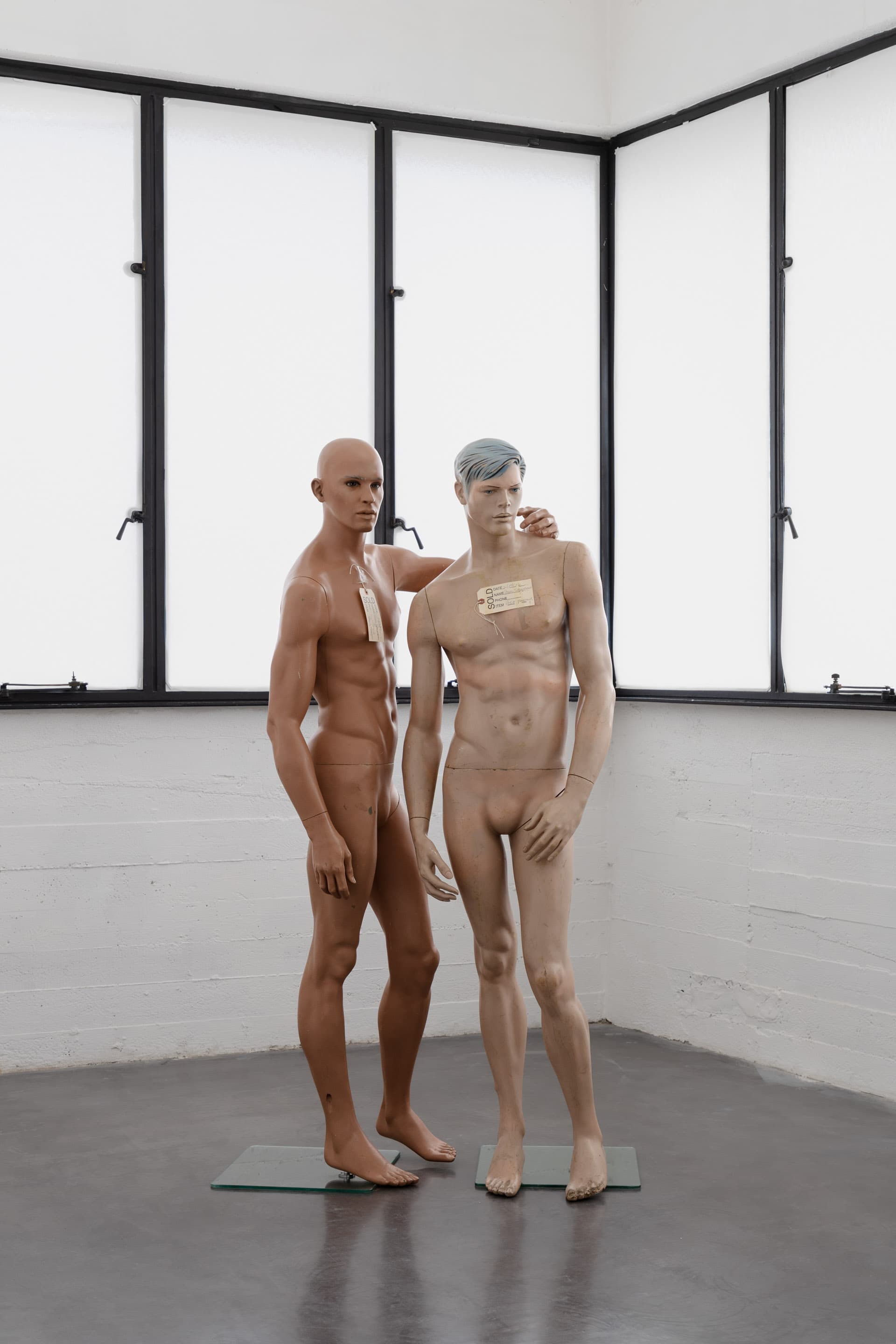
To play a character involves mingling one’s own emotions and experience with those that emerge from the role. Despite efforts to bridge this rift, it persists. Still, the attempted merge is necessary. “Respond truthfully to your body and recognize the gap,” my acting teacher would say. The incongruencies are also material: a worthwhile subject of study. This idea extends to the encounter with a work of art: a negotiation between what the viewer projects and what the artwork itself emanates. The confrontation unfolds in the space between them; there is no overlap.
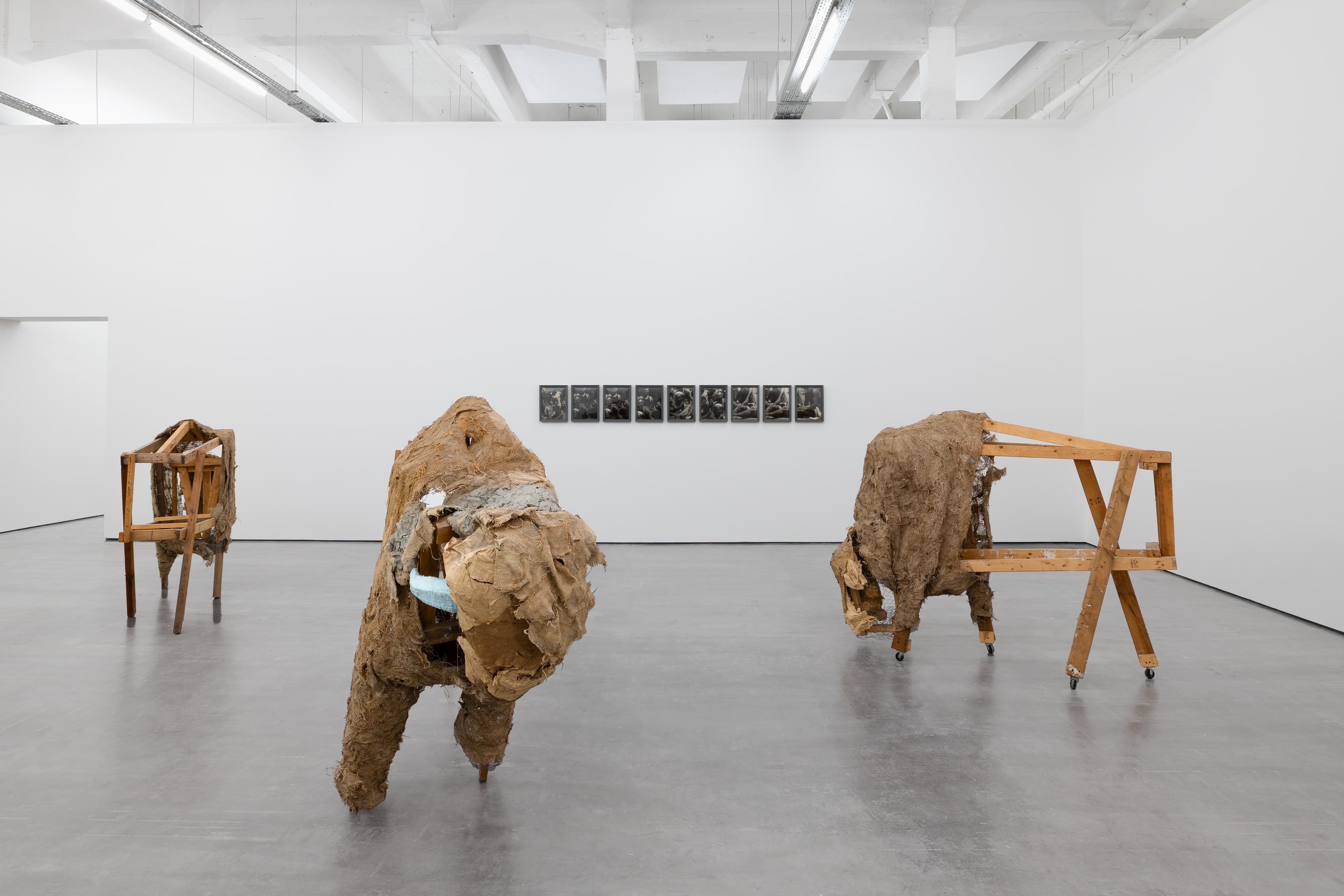
Through her use of a persona, Lutz evades the self, the prescriptions of identity. In a similar manner, her sculptures assume characters in order to resist subjecthood and the associated strictures. Lutz converts matter into symbols, through the act of removal. I weave amongst the sculptures of Bison (2012); the hooves meet the ground in different ways: some land on wheels, some hover a few centimeters above the floor. This discrepancy, in combination with their minimal flesh—patches of papier-mache over chicken wire—evokes a sense of unstable presence. Though the bison are life-sized, I feel as though I occupy more space than the herd combined. As distinct agents, we both flicker.
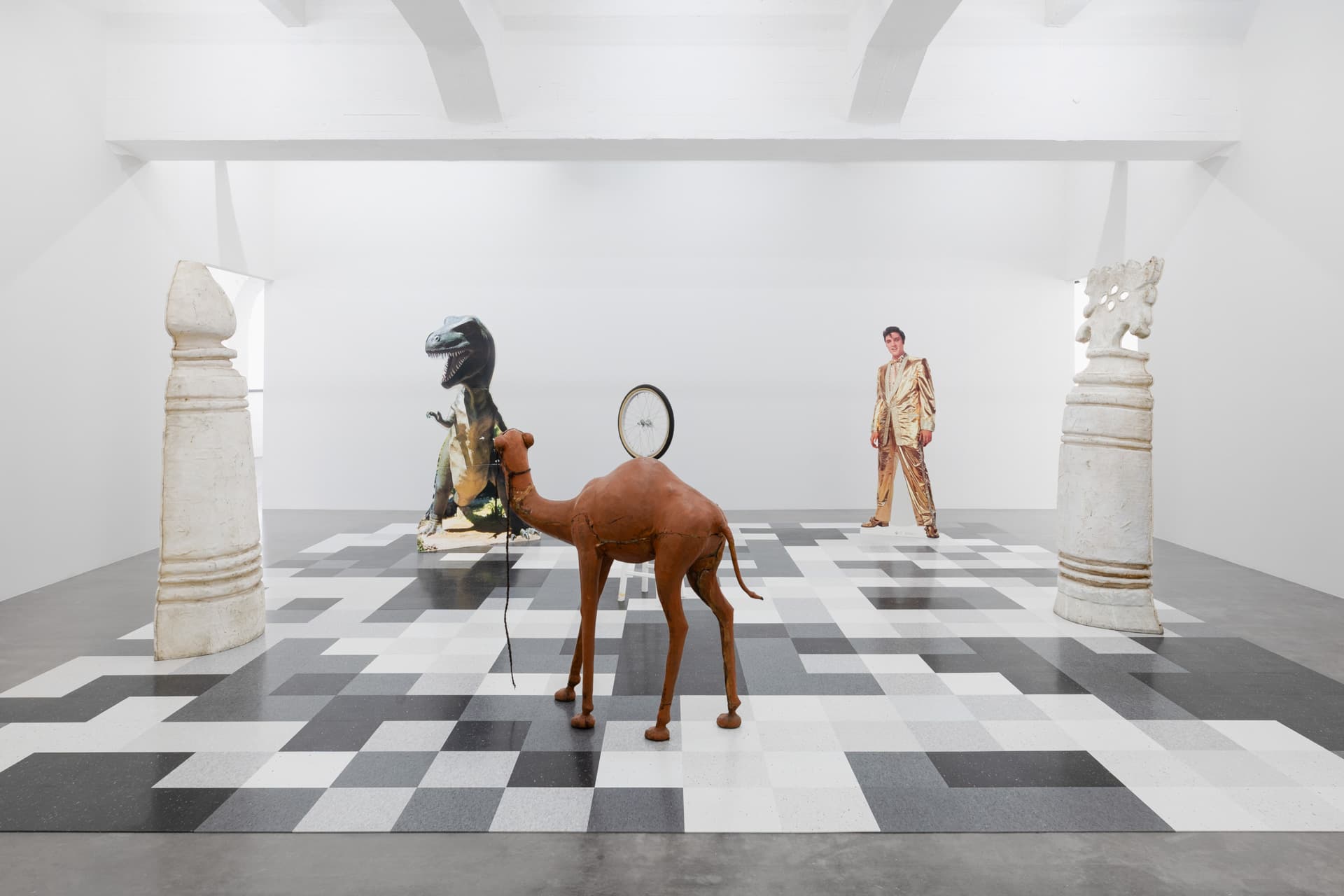
Lutz’s cast members linger in the dawn of a second life; they gesture to an origin while subverting the possibility of their own loss. Still, the potential persists. I maintain my usual posture and gait as I move through the exhibition, reinforcing each curated separation by lingering within it. The intervals between the artworks are inflected by their past and present combinations; likewise, my movement through the galleries is informed by earlier encounters with Lutz’s work. I move more carefully around pieces I'm less familiar with, and with greater urgency around those I’ve met previously. I recognize that I am often bracing in the presence of art—tensing in response to a sense of my self slackening. I repeatedly encounter the walls, which seem to operate as punctuation: commas, ellipses, quotation marks. Yet to construct a rhetorical link would be a misinterpretation; the forms are bound by the low hum of instinctual matter.
In theater, the “given” comprises conditions of a play’s world that the actors must accept as true. The “given” extends from the immediate circumstances. From the presence of a table and chair, to the broader context: war, the weather. It's the raw material: the agreed-upon truths that ground one in a scene. There is a responsibility to the objects on stage; they are as indicative as the actors themselves. We give them life, and in turn they situate us. The “given” functions as a source of possibility, as a threshold; its physicality reinforces the enacted experience, making it more real. In class, we train our ability to submit wholly to the present; we explore the reverberations.
A survey entails a successive encounter with a spectrum of Lutz’s work and exposes a range of “givens,” drawn from many different scripts which we know were written and kept in binders. Lutz’s characters move across these scripts, reorganized by color, category, and locale: they are versatile players. There is confluence—the impact of one thing on another, as it is received by the viewer—but not synergy, which would imply compromise. Whiteboard (2018) is displayed in partial light; I am reflected on its surface, backlit by Manhatta (1999), reversed aerial footage of Manhattan. Written on the whiteboard is a list of “Key Unit Vocabulary,” ostensibly from a grade school history class. Half-erased, the list includes: Bi-Polar World, Berlin Airlift, Kennedy v. Nixon, Harlem Renaissance, Red Scare—referents that shaped today’s “given.”
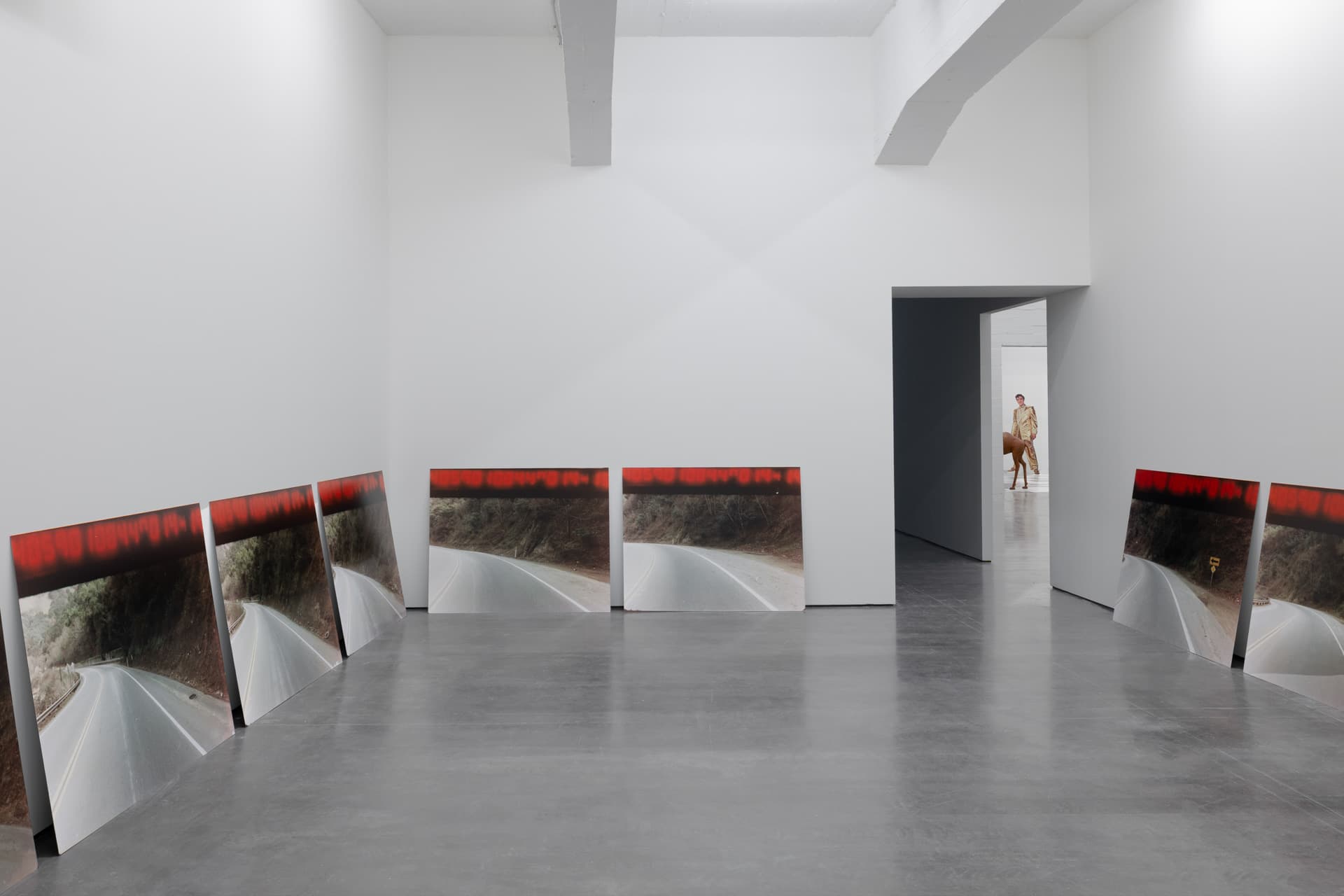
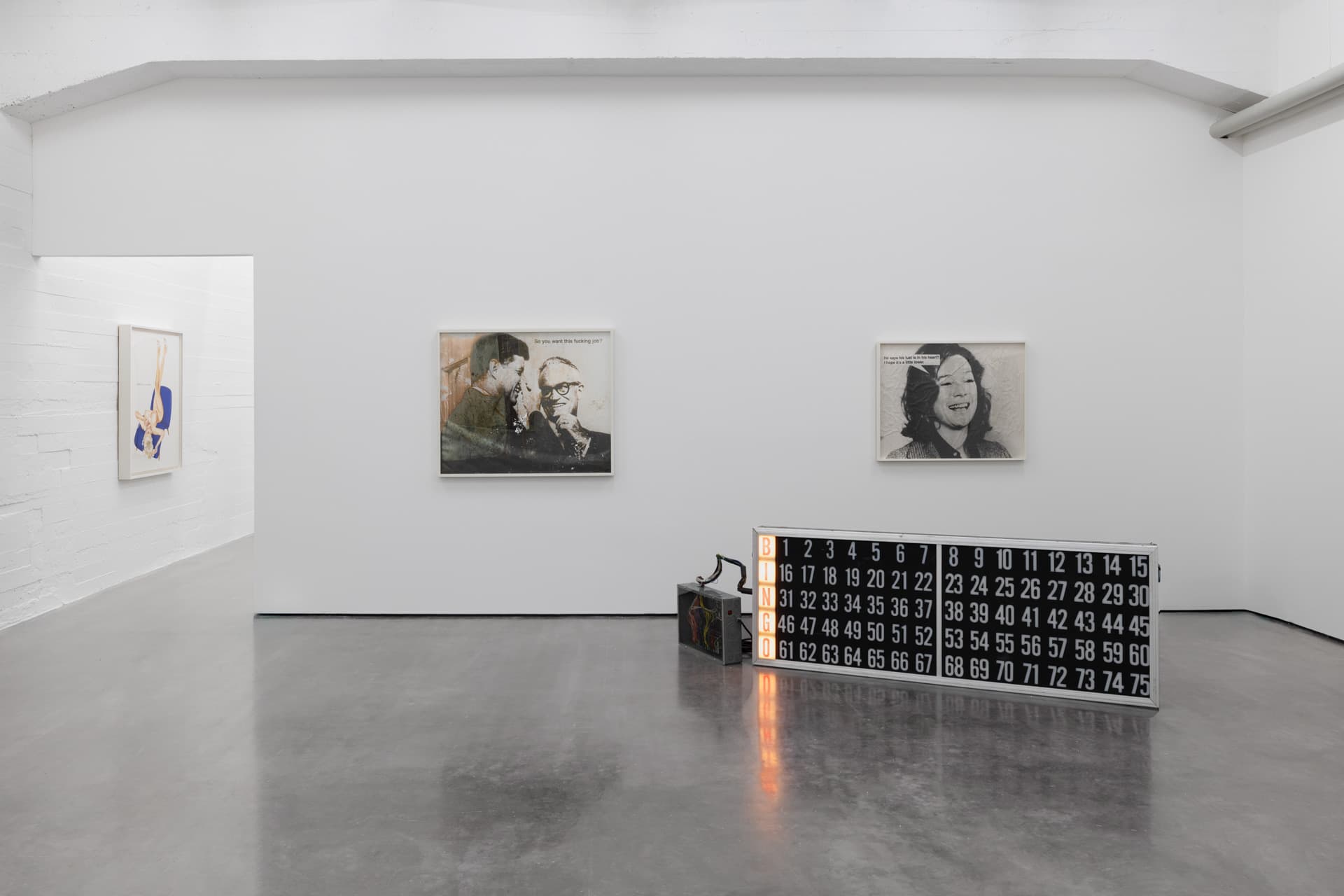
The basis of the Meisner technique is the belief that acting is not about showing, but about living truthfully within imagined conditions. The exhibition, as a framework, is both a fictitious circumstance and a wholly materialized gravity. As a physical absolute, it tends to feel inflicted. As my acting instructor put it, “one has to get as far away from the play as needed, to see the play.” What is held too close often falls out of focus; some withdrawal is necessary to grasp the whole. In World (2003), Lutz miniaturizes the Earth, offering a vantage from which to gaze down upon it.
And to think she loved an astronomer, someone who routinely looked into space and possessed an intimate tether to great distances. And in death, did the portal close? There is the state of lostness, and then there is the effervescent, processual experience of losing. Spectacularly disorienting, loss renders everything strange. There are no patterns to observe; all relations dissolve in limitless projection. Reacquaintance unfolds as a sculptural process—materially driven and conceptually unbound. In my own episode of loss, I was informed of a death in the broad sunlight of late morning. A friend clutched my head, which—unbeknownst to me—had lost buoyancy, had begun to sink. I was positioned on a bench and, suddenly, a chipmunk-like thing was before me, staring, twitching its head back and forth. It was an unreal, shining day, the sunlight was so clear, the brightest I’ve ever known—as if everything was coated with frost, or glitter.
Like Lutz, I’m Californian, and I think affectionately of our home state as I survey the exhibition. Encountering Orb (2008), I see the Griffith Observatory, an emblem of home. I’m in Brussels, and this dome has been so many things, but to me it’s the Griffith Observatory. Behind the dome is a black-and-white portrait of a nipple. I look back and forth between the dome and the nipple, the hair-ringed nebula. As I step away, they engorge. Amidst loss, you ask yourself if there will be a time when the loss isn't the foremost, the biggest thing in the room. I slowly circle the orb. You ask yourself, is life long?
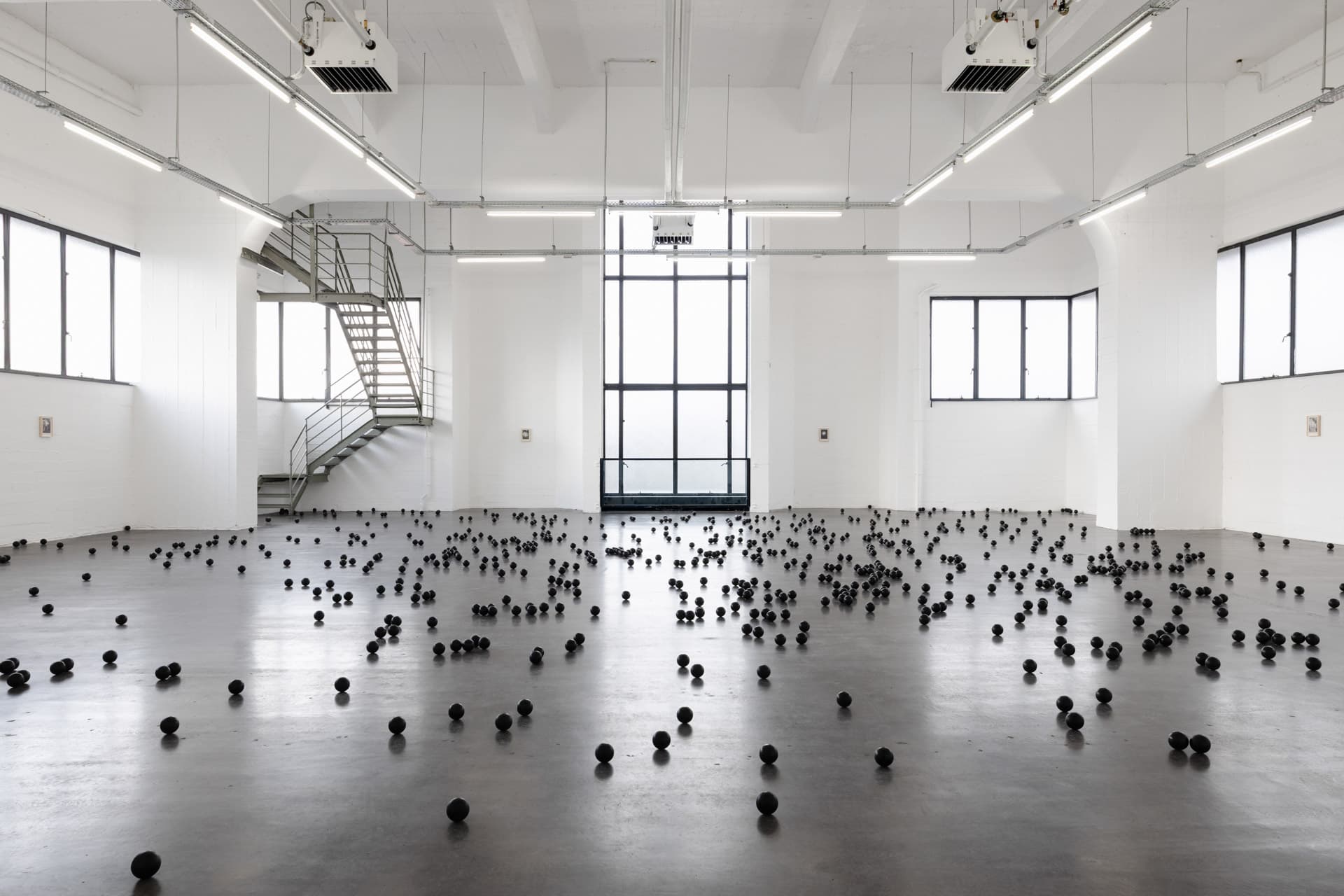
Flying over Los Angeles, one sees the desert touch the base of the snowcapped mountains. I situate Lutz and her decadent scale shifts there, in the hyperbolic landscape of California. The Celestial Handbook (2011), an assembly of cosmic imagery, is the smallest printed image in the exhibition. A depiction of spiral galaxies bears the caption, “Each one of these objects is an entire 'star city,' containing several hundred billion suns. These are the major units of creation.” I navigate the constellation of burnt-out orbs, the universe at cosmic scale, before ascending backward up the stairs to Black Beauty (2013), the coal-filled attic space. Dark specks trickle down, sprinkling the ascent. From the vantage of the stairs, Stress Balls (2012), which litter the floor below, are rendered diagrammatic. Background and foreground conflate. The dark forms are scattered atoms, an expression of disassembly; gas molecules expanding to fill empty space.
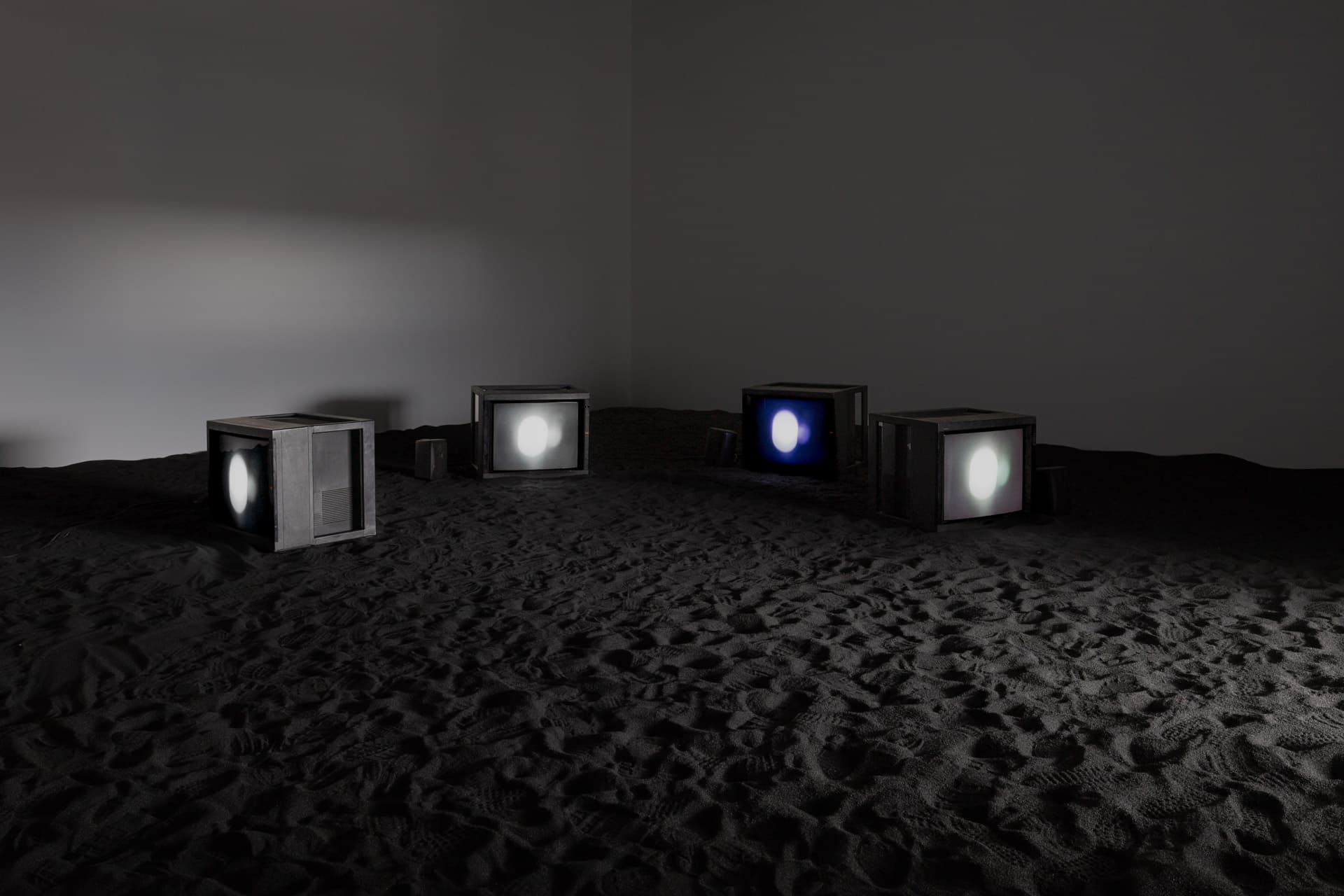
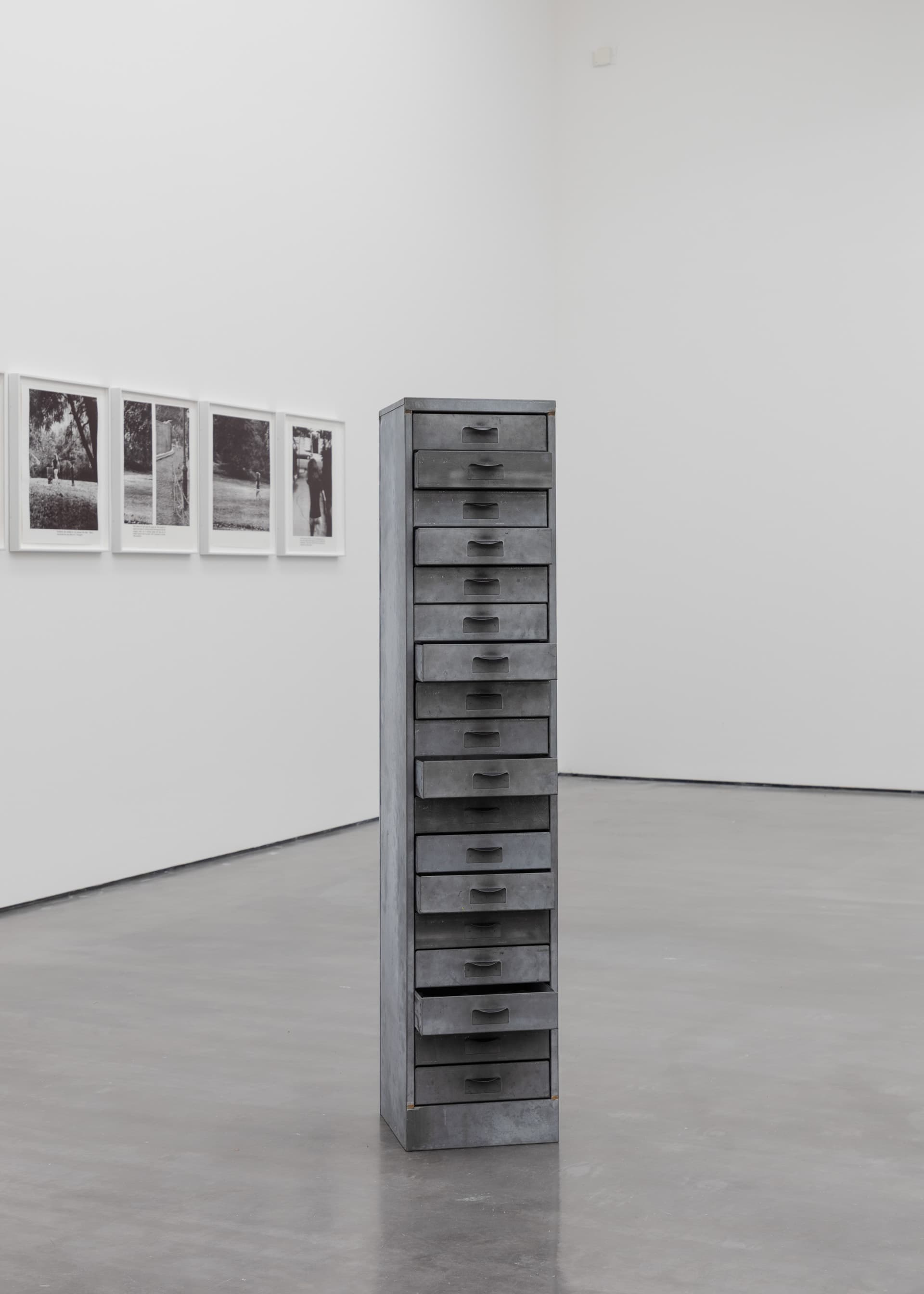
Several months after Lutz’s death, I drove from LA to Irvine to see her installation Blue Wave (2019), which consisted of oversized photocopied sheets, some of them wilted to the ground. One print bore the quotation, “Like a ghost?” In spite of her recent passing, there was a strong sense of a presence—a vague, but authoritative presence—filtering through the space. In an attempt to jog further memories of the excursion, I google Irvine and scan images of beige commercial real estate cast against the setting sun; by contrast, the palette of Blue Wave, I remember, was murky and, like the late hours, slightly silver.
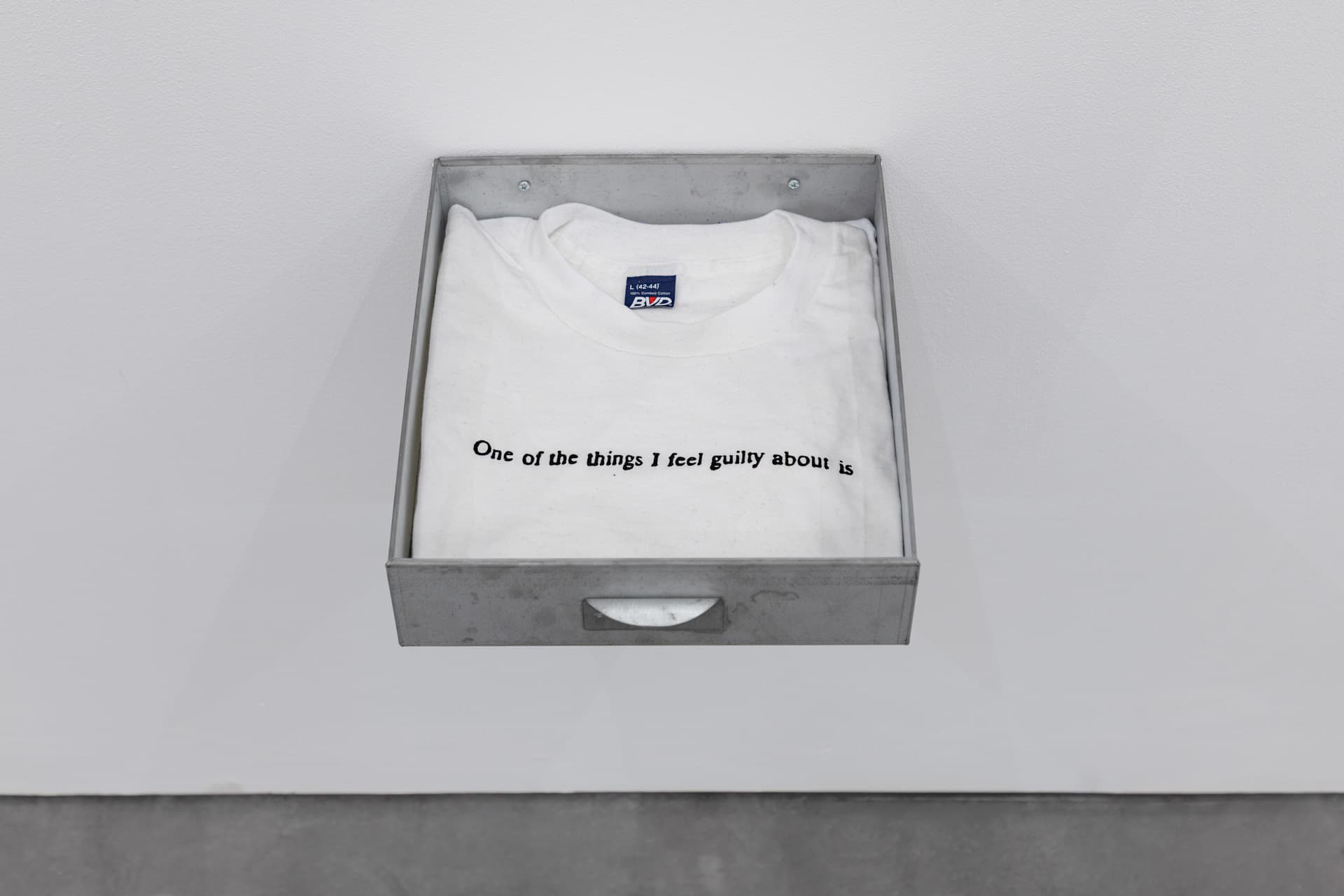
In classical music, a rondo is a refrain that returns in variations, following a compositional pattern. Within existence, loss is a principal theme; it resurfaces in altered form, half familiar. That presence is cast most strikingly amidst its disappearance is an essential recurrence. Absence illuminates: the missing thing appears backlit, its mass obscured, leaving only the outline visible. On the other side of the acting course, the previously accepted constituents of my life were rendered unfamiliar. I clung to the pieces, out of habit, but failed to access what I’d considered “given.” What I did not yet understand was that the “given” had never been absent, only rendered inaccessible through my adjusting perception. What I did not realize at the time was that loss is sculpture.
Camille Clair is an artist and writer from Los Angeles living in Paris. Her practice spans sculpture, image, essay, and dramaturgy. While studying at Städelschule, Camille developed an iterative performance on entropy, which she will continue this July at MUDAM in Luxembourg. In September 2026, she will present an original play concerning the production of a Baroque painting at the gallery of the University of Applied Arts Vienna.
Exhibition view of ‘Lutz Bacher: Burning the Days’, WIELS, 2026. Photo: Eline Willaert.
finanziato dall'Unione Europea - Next Generation EU