Who Will Save Us
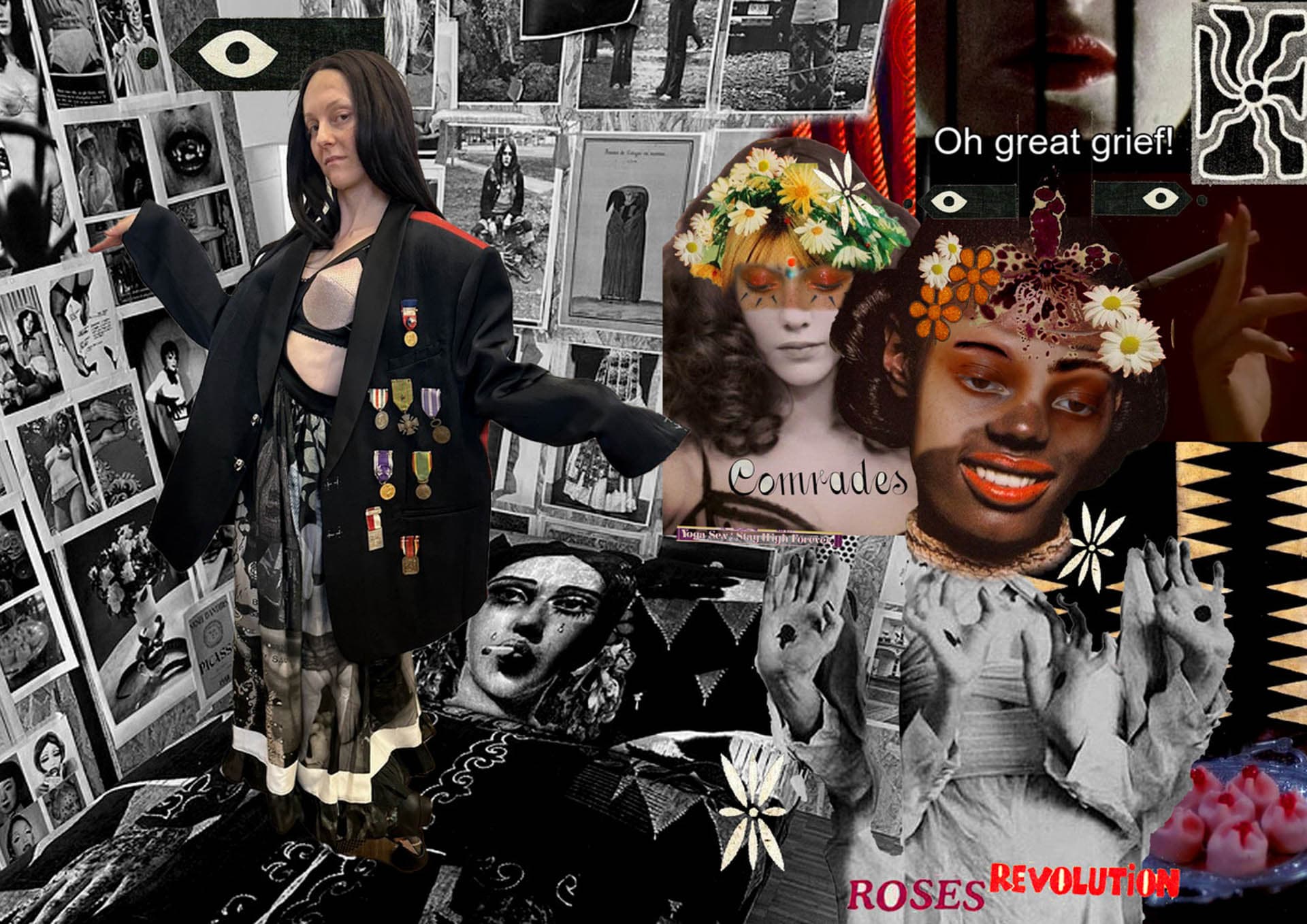
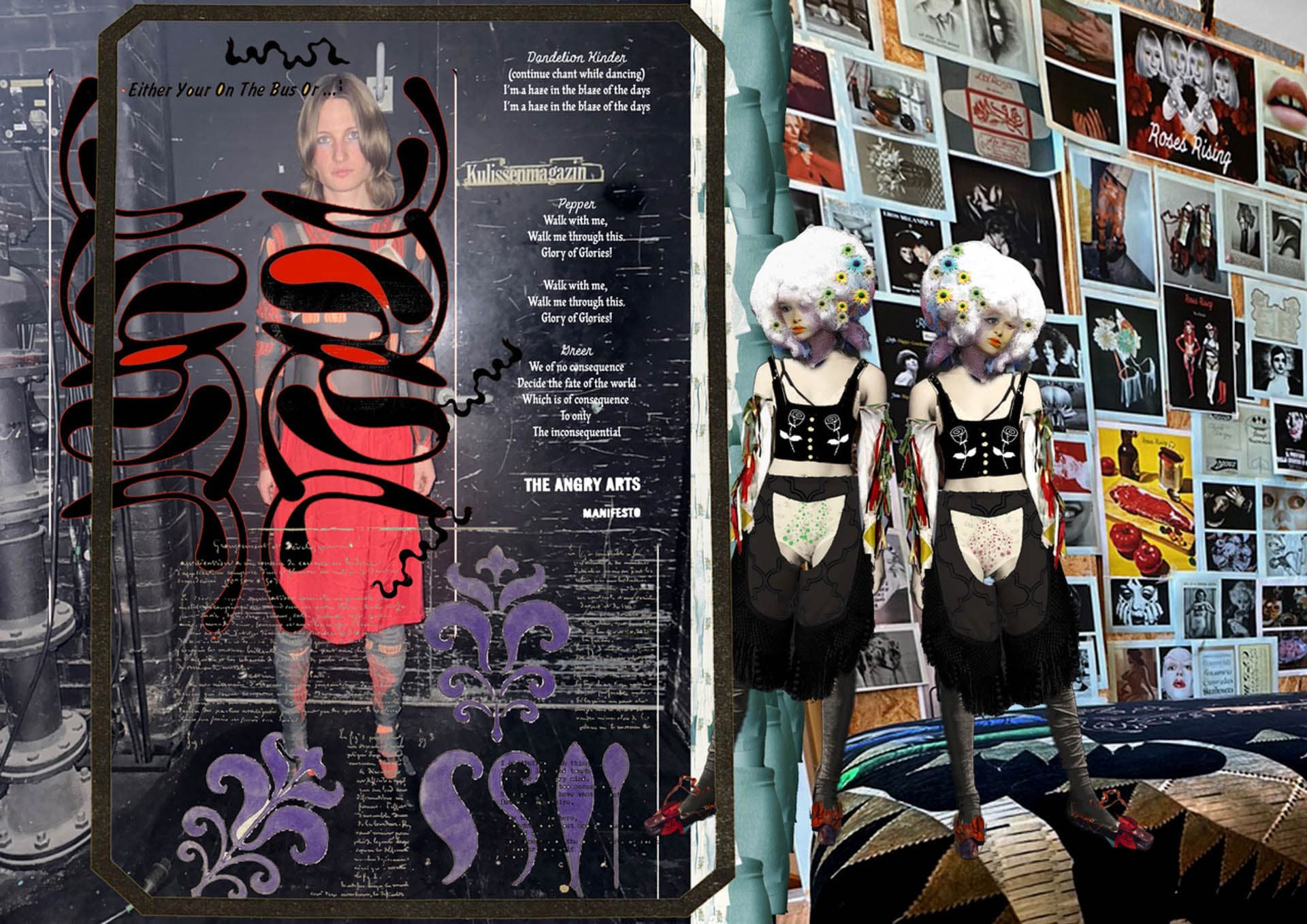
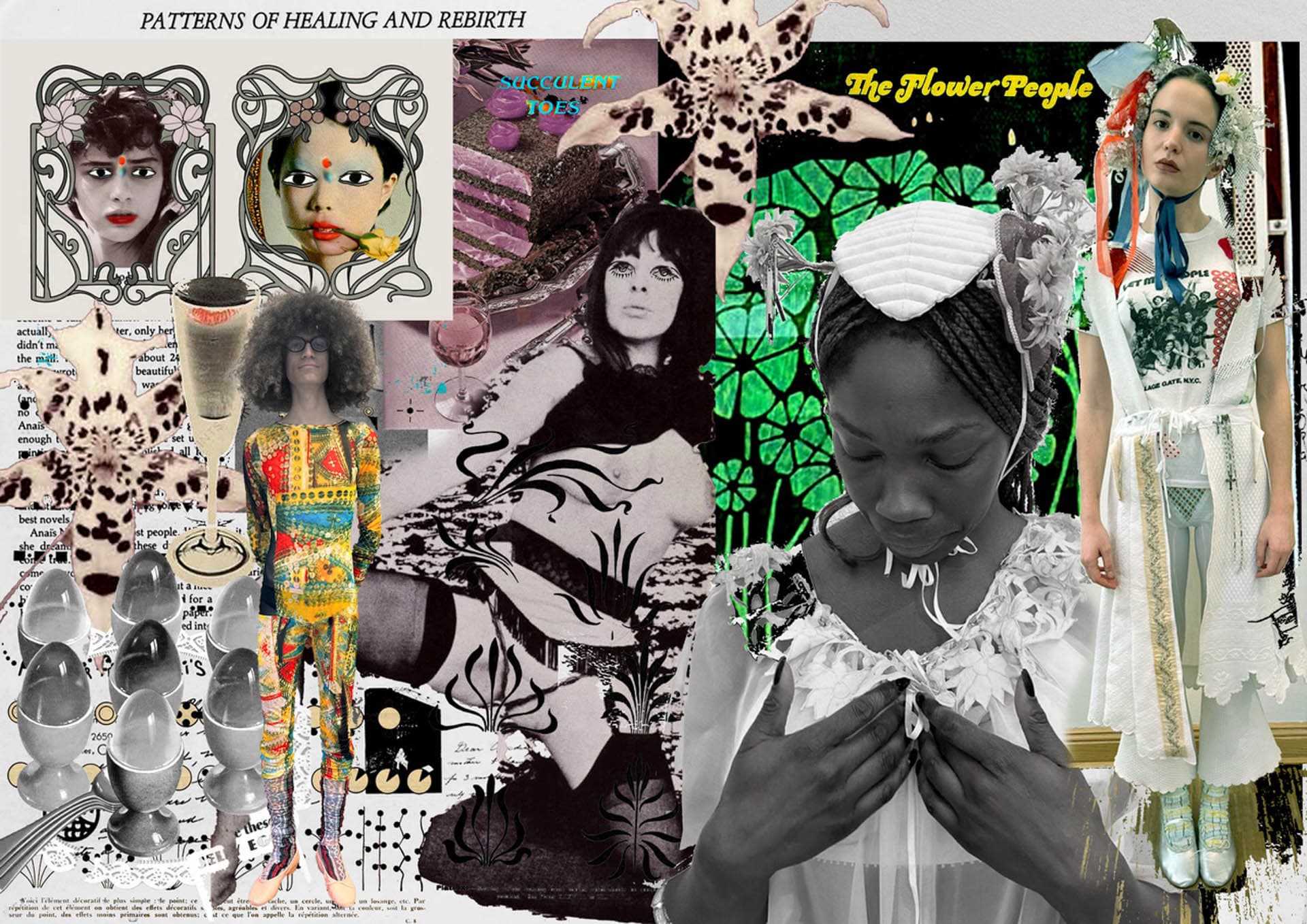
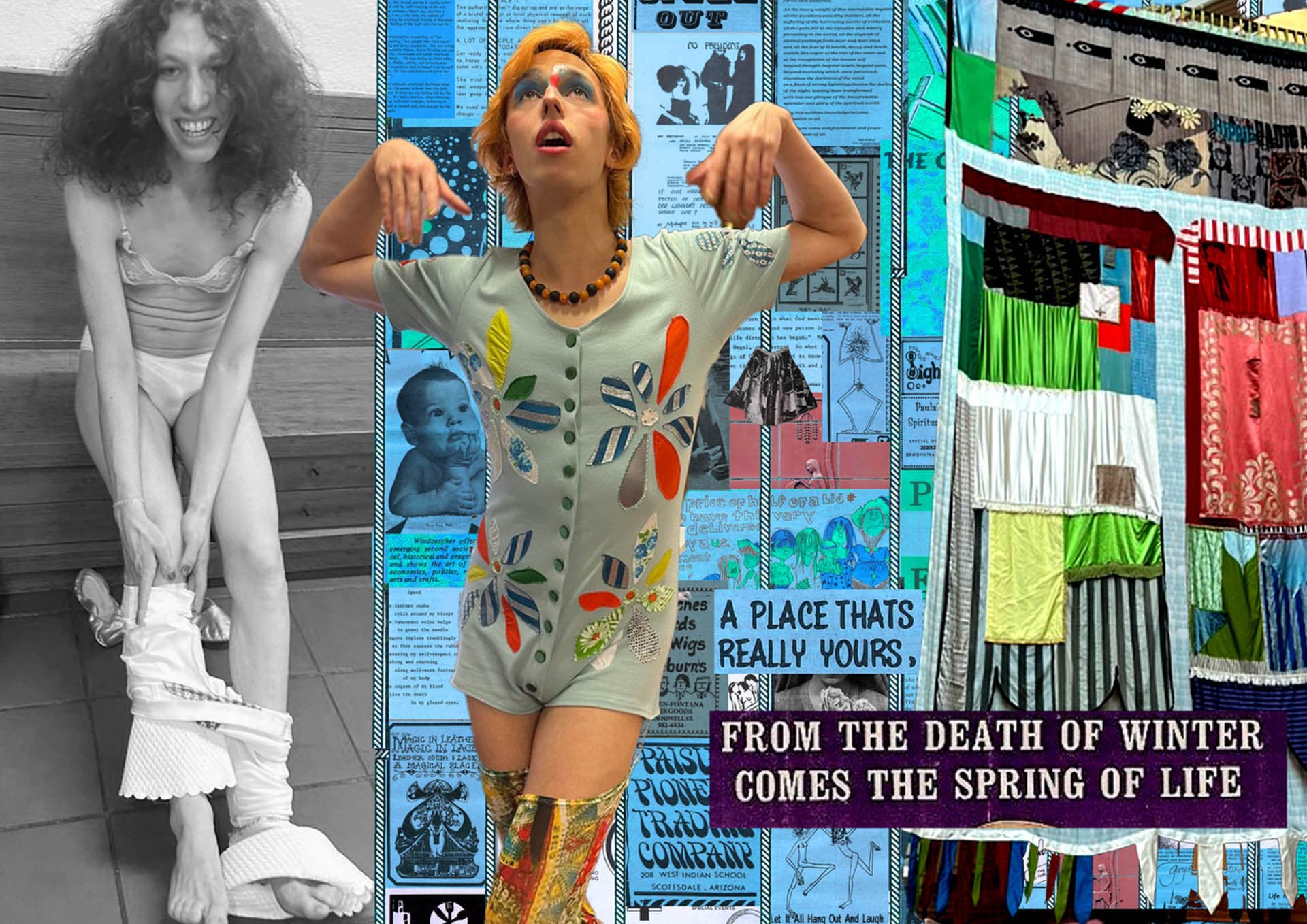
A little over a year after her first opera, Gloriette (2024) premiered, Leila Hekmat started rehearsing a two-part piece that explores ritual, music, and the stage. Roses Rising is an ecstatic, seductive musical in an art institution—Berlin’s Gropius Bau—and its second part—at HAU, a theater in Berlin—somberly reflects on revolution and inactivism. For Chiaromonte, Hekmat created four collages, and a few days before rehearsals began, the artist joined a video call with Philipp Hindahl and Francesco Tenaglia to discuss politics, musicals, and satire.
How are you?
I have entered a phase in my life where I am constantly in meetings. Maybe it is because I’m working with two big institutions at the same time. Institutions always have needs.
Do you rehearse both pieces at the same time?
No. The first show is at the Gropius Bau. The beginning focuses on choreography, and I am preparing my research and references for the team. I always send a lot to everyone: first, a general email with hundreds of photos, YouTube videos, books, and music for them to pick and choose from. Then I send individual emails with specific character references, a rough sketch, and visuals.
Last time we talked, you mentioned Miloš Forman, the musical Hair (1979), and Sartre’s play Huis clos (1944). It also made me think of films from around and just after 1968, like Luis Buñuel’s Discreet Charm of the Bourgeoisie (1972), which play on the theme of enclosedness while a revolution is happening outside.
When I sat down to write the play, I asked myself what the contemporary image of that kind of bourgeois is, of privileged people who live in the safety of not having to fight the war, while being in a comfortable position to contemplate it. And then I’m thinking of these girls. It is vaguely any time, any place, not necessarily the present. But when I imagine these characters, I’m not thinking of four rich women with furs. They are like your friends on Instagram. They are the girls that are like, oh, did you see this? It is terrible, an inconvenience, and an unspoken burden to their comforts. I’m thinking of them as girls who are narcissistic, but you don’t hate them. They live in an entitled, self-centered universe; they talk to each other, but no one is really listening. They are wrapped up in their own longing for self-discovery. By seeing themselves as heroes, saviors, or potential world-changers, they come together as a hybrid of sincerity and parody.
That also implies a certain distance between these people and the world.
It’s in your face, and it’s in your phone, but at the same time, we—in certain societies—are not confronted with it at our door. But that’s absolutely changing. We are watching things unfold in real time. It doesn’t feel as distant anymore. That is the position this dinner is in: it’s happening outside the door. It’s knocking. They are still not ready.
There are many references to Iran in your proposal. Do the protests influence how you work on your piece?
It is definitely more difficult for me to tread because it is charged, emotional, and very sad: the combination of longing for this moment and seeing people risk their lives. It turns into a death cult, like, you’ll have to kill us, and we’re going to kill each other. That’s what it feels like. I have a bleak view, and it affects my family and me. It is hard for me to bring it into the world. In Roses Rising, the Persian ballerina from the Staatsballet sings a very famous Iranian song. It has a very nostalgic feeling. It was a way of infusing this part of my story into it that isn’t so explicit, but of course it is because she’s Persian, and she’s doing a Persian dance. Every time I play the music or talk the scene through, it is devastating. I don’t know why, but I’m a little reluctant to get personal. It feels exploitative, and I don’t want to be an opportunist and take this moment, although it is the moment.
There are many depictions of revolution as an idea. It is a charged concept, but when it is actually happening, it’s quite terrifying.
In my lifetime, that word was used constantly because it was the term we used for change, the moment my family came to the US, when their lives changed. There is a before and an after. Growing up in a society removed from such a thing, it became a very abstract term. My parents came to the US to study in 1976. Then they just didn’t go back. They studied medicine in New York together, and they got married. They couldn’t go home because my dad is Jewish, and my mom is Muslim—which is against the law in the new Islamic Republic. But about the dinner: when I work on a piece, I make the script very solid with a lot of information and all the references. This time, I’m trying to be more open, and I leave more space for workshopping with the actual performers. The dinner party features six of them. It is quite intimate, and I know all of them well. They are all artists, not trained actors. I talked to Diamond Stingly in the beginning, one of the performers in the pieces, and she said, “Oh, I’m really happy about this. I have a lot of beef with this poser activism that is part of our everyday vernacular.” So, the question was, how to make characters like that who are also quite likable?
Do you think the musical Hair is about morals? About how to be a good person?
For sure. There is a scene in the movie Hair where all the hippies are in the park. They are called the “Tribe.” There is a white hippie girl who is eight months pregnant, and she doesn’t know who the father is, but they don’t care because they are all a family. Maybe that’s fine. A black guy and a white guy walk together when a woman yells from across the park. She says a name; nobody turns around because the black guy changed his name to some hippie name, but she calls his real name as she’s standing there with a little boy. Everybody asks, Who is that? Do you know her? Then he gets upset, runs over, and asks what she is doing here. Suddenly, there is a rift in the happy hippy picture. Reality comes in. The song she sings is a really good moment because it tells us we are watching these hippies posing as the people who are doing good, fighting the man, all that. Suddenly, that guy is also an asshole who abandoned his wife and child to break free. In the lyrics, she just says, I need a friend; why don’t you help someone who’s actually in need, someone you know.
It is a moment of rupture in the illusion of being good when the woman dead-names him. Do you have moments of rupture in your piece?
There is one in the happening at Gropius Bau. There is a lot of hippy spirituality, and drugs, and then one character breaks and turns it into a punk song. There is a lot of contrast between what the music and visuals say. But I am trying to find a religious experience in this. Somehow, in the end, I want people to say, I want to join that movement, that cult.
People seem to hunger for this kind of spirituality. I am thinking about the recent Rosalía album Lux, which is inspired by the lives of female saints.
It is interesting to see the rise in religious spirituality. I mean, I’ve always been into cults. The question is, how do you inspire people to join you? There is a dark fascination in this power of manipulation and in the way people fall for things. Often, it starts with religion and then expands into something else.
Your piece has two parts. The dinner takes place after the revolution, after this ecstatic moment. When I watch it, and you get me to want to join the cult at the end of the happening, I will know what happens after. A paradoxical position for the viewer.
It is going to take persuasion. Hopefully, as long as you know that there is a backstory, you’ll want to see it. If the ingredients are potent enough, the power of seduction is there. Visually, the two pieces are very different. The play at HAU is text-heavy, and it is a different experience. The two institutions are down the street from each other, but the people who see things here and there are very different; they have different questions.
And Berlin has a very specific theater tradition.
I would say something is lacking in theaters, especially in the production values of state theaters. The aesthetics are horrible. But they have the money, so what are they doing with it? It is devastatingly outdated. German theater is in cobwebs. You're going to see some man stand up and yell at the audience for like twenty minutes straight. Somehow, that is a method of acting taught in acting schools.
When I saw your opera Gloriette (2024), I thought your visual language works so well as an opera. How did you arrive there?
I didn’t arrive anywhere with intention. The reason I was moving towards theater was financial. I was working with a musician who told me about the budget he got for his theater collective. My brain exploded. I thought I had to figure out how to get this. The cost of a performance is really in the labor, and for some years it’s okay to do the punk thing and pay people a few hundred bucks, but it’s not really okay. Museums don’t think about performance like that at all. I’d have to say no to invitations because they would offer me a thousand bucks. What am I going to do with that? I’m not a bar mitzvah singer. Pivoting to theater was exciting because I had access to their infrastructure. We have health care, and I didn’t have to do the lighting myself, and I was able to pay people a somewhat living wage.
In the art world, people assume the money comes from sales.
I’m an anomaly. If you don’t have a material practice, you have to figure out one to sustain your performance. You can’t always assume that people—even those who are well-known—make money. Most people don’t.
And people would get rewarded with more work.
You get institutional shows; maybe somebody will think you’re important. Sorry, I’m so cynical today somehow.
It’s okay to be cynical sometimes.
I do like the black box experience that a theater offers, and I’m excited to do it again. I always think of the stage as having the potential of turning into something like a dark Caravaggio painting—that’s how I was thinking of Gloriette.
Musical theater is interesting because it is a synthetic form; it has to say something big, using signifiers that a big audience understands.
I grew up in Los Angeles and in Hollywood, and I had no interest in theater. We watched movies; that was the art form of choice in my family. But I figured that musicals are a great vehicle for satire; that’s why that is my main interest. I watched a crazy and brilliant film last summer, Magic Christian (1969), which is based on a novel by Terry Southern, who wrote Doctor Strangelove (1964). The movie stars Peter Sellers and Ringo Starr, who is a homeless kid in the park, and Sellers picks him up and adopts him as a son and shows him the way of the world. He has disposable money to burn, so they do absurd things, and he teaches the kid his ways. It is the darkest capitalist satire I’ve ever seen. The scenes have little connection, as if they travel to random places with random people. I took this as a direction because in past works I was never as explicitly political as in Roses Rising, especially in the second part, at the dinner. There is more room for dialogue to articulate these figures' positions. It is only challenging that irony is sometimes lost in Germany because my humor is very specific, very referential. It doesn’t always come through, but I still try to create something where you can take something away, something spiritual or some kind of joy. I do really care about entertainment value.
Where does the loss of irony become palpable?
In certain responses, from journalists or the more classical theater establishment. It feels hard to penetrate. The work succeeds because I have the support, funding, and opportunities. Somebody must be into it. But responses and reviews often miss the point. It is a bit frustrating, but it doesn’t really affect me much in the end. People in the audience at Gropius Bau told me it was weird that they sat there laughing, but no one around them did.
How do you work with your references?
I start with collecting photos of garments, things that could be used as costume references, images of people that could be references for characters, settings, scenography, colors, collage, and materials. I collect images and books, and then one book leads to another. Then I go through every single text and collect what could be used for dialogue and for music. I categorize everything: the images by character and by purpose. I collect dialogue from films and interviews, as well as personal anecdotes from former entertainers and celebrities. There are some texts that form the body, such as those by Aldous Huxley and Timothy Leary. They were the two main references for both scripts. Everything started for me with The Doors of Perception (1954). Huxley’s book created an existential journey; it uses these deliciously extravagant metaphors. I wanted to try to bring this psychic voyage, which Huxley and Leary were so enamored with—these alternative universes that would create mind expansion as a space to envision a better future. And then I find the flaws, sadness, and irony within that space.
There is a desperation to it. Do you think the piece is a cynical parody of someone who envisions a better future through a shared belief?
It is the opposite. Part of me considered this church-like experience, and the way people gather in that space. I wanted you to walk away with a little bit of a desire to be part of something, as idiotic as it seems. Something feels good about this. There is a song in the piece that goes, Who will save us? Who's going to be our savior? The world is collapsing around us, and we’ve been raised over the past decades of relative peace with the mentality that someone will fix this eventually.
Like a messiah.
That is the feeling in all these people’s minds as they doomscroll, seeing pictures of war mixed with cooking recipes. Who is our savior? Who is it going to be? Is it you or is it me? I’m not saying there aren't people motivated to try to make a change. But when I look around, it feels like everybody is waiting for the Messiah. Simultaneously, there is a more optimistic side to the work. The performers are people I’ve known for a long time; they are friends with whom I’ve worked on other pieces. I started the rehearsals with this Osho meditation. There are Rajneesh exercises where everybody is blindfolded, and you shake for fifteen minutes. Then you dance for fifteen minutes, then you lie down for fifteen minutes. I’d do this with the cast. The first time, they thought it was quite insane, and it was. But I wanted to see what this does for the group. It was extremely exhausting, but of course, everybody was converted. There was something that would loosen some inhibitions and create a common humor around it, where everybody would laugh at it, but we’d also talk about the experience. It created a genuine feeling of community within the cast. At some point, the work took over, and we focused on getting this done. At the end, it felt like something had happened between everybody. The affection they had for each other and for the work was like something from a hippie spiritual cult.
The meditation seems like an invisible extension of the piece. Not for an audience, but related to the stage piece.
The choreographer also intended to create a common language of movements with it. At some point, we did it without the blindfolds. It became a way of moving together, creating a shared organism. The audience can feel it. The musical Hair may embody everything you hate about musical theater. But it is so good and so funny. To see the dancers running and skipping, smiling and holding hands, that is infectious. You also see the stupidity of the hippies; a lot of them were totally inactive, not really making a difference.
And yet the hippies, for all that, at least tried to make dominance beside the point. Punk never quite managed that, did it?
I really like the beat poets, and in The Dinner, Allen Ginsberg is a big comedic reference. We did a portion of the poem Howl (1956) as a musical sequence in the first act. By the fourth act, I had a person on stage, like a naked Allen Ginsberg. For me, that is in the Huxley and Leary family. Human rights meet poetry, meet radicalism, and war.
Leila Hekmat is a Berlin-based artist whose work merges installation, performance, film, and music into vivid tableaux of baroque satire. Through handcrafted costumes and stage designs, she constructs worlds teeming with detail that subvert and play with social conventions and the constructions of sexuality and gender. Her meticulous use of collage draws on historical references ranging from commedia dell’arte and vaudeville to 1970s protest and TV cultures. With humor and excess, Hekmat’s works unravel the tangled follies of power, morality, and desire.
All images courtesy of the artist.
finanziato dall'Unione Europea - Next Generation EU